Your AI Revenue Is Growing. Your Business Is Rotting.


For simplicity's sake, I will be using the terms LLM and AI interchangeably.
Over the past 16 years we saw companies soaring in revenue only to hit rock bottom all of a sudden. Take how WeWork went from a valuation of $47 billion to below $500 million before declaring bankruptcy. Or how MoviePass rocketed from 20,000 subscribers to over three million in under a year, with revenue passing $150M ARR. the business grew at lightning speed towards a cliff it built for itself. And Zenefits was claimed to be the fastest-growing SaaS in history, reaching roughly $20M ARR in its first year, with a valuation of $4.5 billion, until it was caught with illegal practices in an attempt to save its bad unit economics. The repeating theme is the cost of delivering the value exceeded what the businesses could capture for it, and growth widened the gap instead of closing it.
The AI era brought numerous changes to the software business landscape. Today we are living the AI-era version of the collapse phenomenon affecting different layers of the software industry. Like many founders and professionals, I spent a decent amount of time in the old growth frameworks of PLG and SaaS. Things worked, then LLMs entered the scene, along with other economic, social, and cultural changes boiling under the market floors. LLMs introduced a ghost that haunts revenue quietly, further separating value delivered from value captured, and rotting revenue for businesses that are unaware of what has changed to cause the difference.
A critical risk factor that is tricky to see and solve within a company is difficult to figure out when teams are sprinting to build at the rapid speed of AI development. To identify what we cannot plainly see, we can take a step back and observe the obvious visible changes. AI models introduced a new cost for software products incorporating LLMs (some more heavily reliant on them than others). AI comes with a new kind of bill: token cost. Every time someone uses the AI inside our product, it costs us money. Unless we're the ones building the AI models ourselves, we pay this bill from day one, for every user, and as our customer base grows, our cost grows. This change led founders and operators to gravitate towards thinking in margins, directly and indirectly. With that, a question introduces itself: is margin thinking beneficial?
The origin of thinking in margins is logical and generally viewed as good business practice. We take the cost of goods sold (COGS), add a margin on top of it, and the resulting total is the selling price. While generally a good practice, it can be fatal for software companies to adopt this thinking based on LLM actions. When the core value offering is largely based on tokens and margins, the business is actually selling margins, not value, leaving it vulnerable to supplier price hikes.
Once a price increase happens, margins shrink and the business gets squeezed from both the supplier and customer sides. The way incumbents like Anthropic and OpenAI price their products is similar to that of electricity providers, although they are experimenting to find ways out of it too. Instead of a meter counting your electricity consumption in kilowatts-hour and handing you a bill at the end of the month, it's a meter counting the tokens your product burns through, and handing you the bill all the same. The unit changed from kilowatt-hours to tokens, but the logic didn't: you pay for what runs through the pipes. For the time being, it is feasible for incumbents to rely on selling tokens, because they have subsidies, government backing, and a huge war chest. They have an inherently different DNA and are playing a different game, one that is not fully applicable to startups, scale-ups, and businesses that have drastically fewer subsidies, less backing, and no war chest to lean on. So what is the solution if it's not margins?
You've probably heard "price on value." It sounds generic when everyone thinks they are pricing on value. This is one of the reasons why so many AI companies aim to reach outcome-based pricing. Instead of charging for tokens + margins, it allows the customer to pay for the value of having the whole process taken off their plate. A problem that is worth $500 to the customer might cost the solution provider $20 in tokens, but reaching that outcome took a lot of thought and design, directly contributing to its success. Not all industries are ready for outcome-based pricing yet. As a temporary solution, many startups and scale-ups dress COGS/margin as value pricing in their messaging. The difference is that this is only a customer-facing claim. Saying you price on value doesn't make it real, because delivering value isn't the same as capturing it. Pricing on value is a necessary piece, but on its own it isn't enough to make the claim hold. What holds the value claim is the structure underneath: whether the value you deliver leaks out or stays captured. So it's a question about structure, not pricing. What is the structure that makes the value claim hold?
Building a product that doesn't live on margins is structurally similar to building a virtual factory that charges rent or pay-as-you-go rather than one-off payments. The elements (floor, fences, equipment, tools, storage, and infrastructure) are mostly present. The floor is where customers enter the product: they move freely, test the solution, and understand the value it delivers. Tokens are mostly part of the floor at this point, like electricity. Imagine walking into a factory in real life. Without electricity, it is not possible to produce things. The floor, while important, is not where captured value lives. Take the abundance of tools able to turn plain text into a website or dashboard as an example.
A virtual factory (aka product) with only a floor is a factory leaking value, living on margins, and waiting to be copied or absorbed into a category. On the other hand, factory fences and infrastructure are the machines, assembly lines, storage, and quality control that actually turn electricity into finished products. Electricity runs through every factory on the street, so it's never what sets one apart. What differentiates a factory is what sits on top of the power: the equipment, the processes, and the know-how built up over time. In software, those are the fences/infrastructure, and they translate to buyer operational needs, execution and orchestration, learned context, multiplayer effects like collaboration, deployments, and workflows that differentiate the product for specific segments. You can think of them as AI-native operating systems. Building them is what turns a powered-up floor into a product that adds and captures value, not just sells margins. Taking the scenario of a heavily margin-based software product, the floor is doing what it does best, and value is delivered to the customer from day one. Once supplier price hikes come in, margins drop, the customer refuses to pay more, or the business falls before that when model providers absorb their customers. A case in point is the content generation product Jasper AI's revenue decline: after securing $125 million Series A funding, revenue dropped from $120 million ARR to $55 million within a year from ChatGPT absorbing their leaking value. Many startups are closing down under the radar due to this leakage; the startup Relay.app (total funding $8 million) is one example out of many that don't even make it to the news. On the other hand, a product capturing value is less dependent on margins, value is decoupled from tokens and base models, and revenue grows without widening a gap between value delivered and value captured. If we look at products as factories, how can adding fences and infrastructure help, and what does it look like?
Good factory fences capture and add value simultaneously. They defend the business against the margin squeeze, since value is not in mere token conversion; avoid substitution, due to reliance on valuable operational workflows; and hold the structure for value-pricing in return. In the case of Jasper AI, their pivot was to fence the product and turn it into a content operating system for marketing departments in the enterprise segment, finding their value capture most possible upstream, given existing enterprise accounts in their customer pool signaling high intent with organizational operation needs. When you have the floor, building up the fences and infrastructure is what makes the product a virtual factory. Another example of a properly fencing product is the famous company Lovable, mostly known for transforming text to website/app with beautiful designs. For Lovable, token conversion is the floor too. Turning a prompt into a working app is the electricity, and anyone has it. The value lives in the fences, everything Lovable wraps around that generation: helping customers improve what they're building, deploy, edit, share, collaborate, handle domain issues, work inside a structured workspace, and stand up a real backend and database through Lovable Cloud and its Supabase integration. These are the factory elements handed to the customer, and they're what let Lovable empower a new segment of less savvy builders who couldn't assemble that setup on their own.
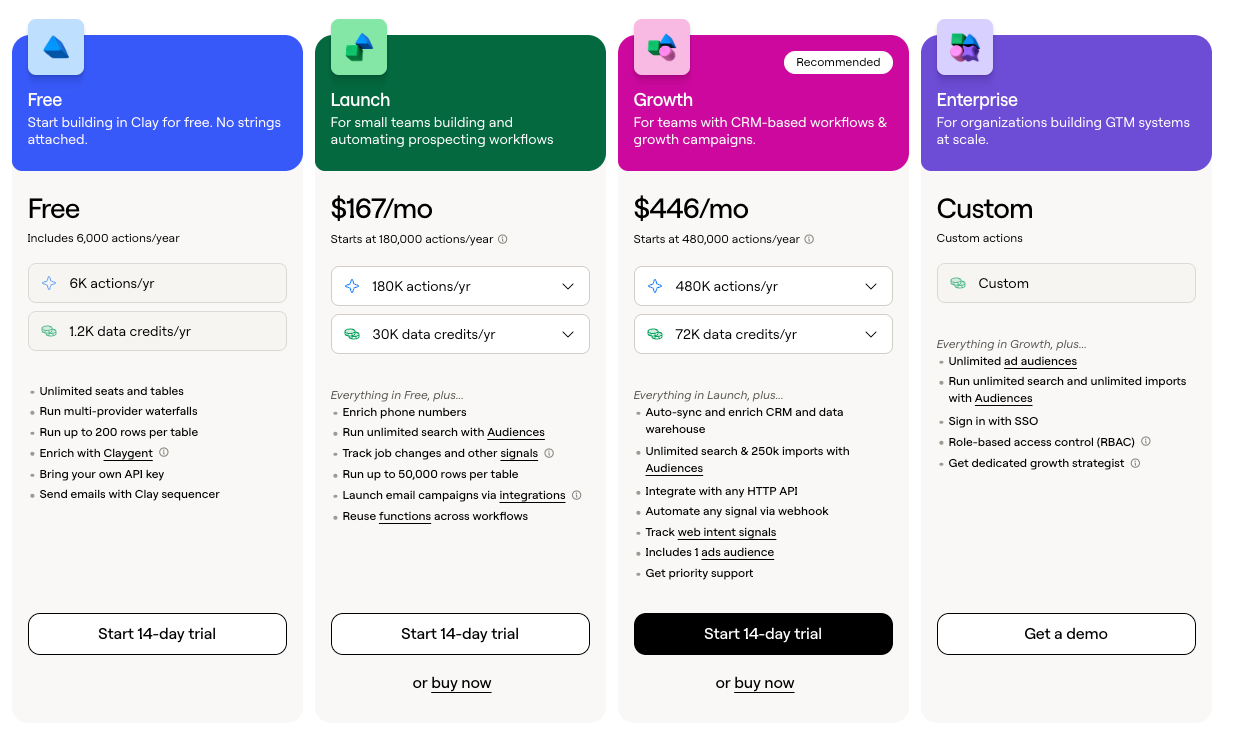
March 2026, Clay publicly decided their value was in platform usage, not model usage. So they started the gradual migration of their value definition, removing seats and focusing on monetising platform usage through Actions (Clay's own tokens, built on actions performed such as launching campaigns from tables made and maintained). This turned Clay from a cheap control panel for external data into a metered system of record for GTM workflows. No seats, and capped usage-based pricing where all sales reps rely on a single account's Actions. Clay found its value capture, leaving "data credits" (their metric name for incumbent tokens) at near if not total break-even, treating it more like a commodity.
What Clay did was position itself closer to infrastructure software, where orchestration is the value, making it less reliant on external providers for its revenue. Analysts estimate Clay hit $150M ARR in May 2026, up from $100M in November 2025.
Avoiding the trap of pricing on margins, determining the floor, and building the factory fences lead to captured value, and in turn enable value-pricing. Done and maintained properly, this is the point where revenue can grow and value is both delivered and captured. It's easier said than done, often requiring careful consideration, brave leadership, and planning. Not all companies have the willingness and the ability to move through this transition. Those who do carve a path to sustainable value-based growth, decoupling their worth from hype. The stronger the fences, the stronger the retention, durability, and profitability. Those who fence-up endure, before and after the token-spike reckoning arrives, and avoid being absorbed or substituted. The rest risk serious revenue rot and sudden collapse.
For software business operators who sense the difference between durable and hype-inflated revenue, I turn that sense into action and results.
Got a nagging sense your software could be worth more than you're charging?